

Want more traffic to your store?
We’ll check your SEO, give simple tips, and set up a quick call to talk.
Most cosmetics brands have the same problem. Beautiful website. Stunning product photography. Compelling brand story. And absolutely nobody finding them on Google.
That’s a visibility problem. And visibility is almost entirely an SEO problem.
The good news: SEO for cosmetics brands is learnable and repeatable. The brands dominating search right now aren’t necessarily the biggest or best funded. They built a smarter strategy around how their customers actually search.
Here’s what that strategy looks like.
Why beauty SEO is so competitive
Beauty buyers research obsessively. According to Think with Google, 66% of beauty shoppers turn to search to discover new products and brands. They don’t search once. They search at every stage: to learn about an ingredient, compare two products, find the right option for their skin type, then check reviews before buying.
That creates something rare in ecommerce: a multi-touchpoint search journey where a brand can show up 5 or 6 times before someone adds anything to cart.
Brands that understand this build content for every stage of that journey. Brands that don’t build one product page, load it with brand language, and wonder why organic traffic never shows up.
What Google actually looks for on a cosmetics site
Google doesn’t rank pages. It ranks trustworthy, relevant, well-structured content that serves a clear user need. For cosmetics brands, three things matter most.
Topical authority
A skincare brand with only product pages looks thin to Google. A brand with content around ingredients, routines, skin concerns, and beauty education signals genuine depth. That depth is what builds rankings across an entire category, not just individual pages.
E-E-A-T
Google’s Search Quality Evaluator Guidelines treat beauty content as requiring demonstrated expertise. If you sell a vitamin C serum, your content needs to reflect real knowledge about how vitamin C works in skincare. Marketing copy about how the product smells doesn’t do it.
Page experience
Core Web Vitals, mobile usability, page speed, site architecture. A slow, poorly structured store struggles to rank regardless of content quality. Technical SEO isn’t optional; it’s the floor everything else sits on.
Most cosmetics brands target wrong keywords
This is where brands go wrong first.
They target “moisturiser,” “foundation,” “serum.” These terms have huge search volume and almost no chance of ranking unless you’re Sephora or Boots with decades of domain authority behind you.
Effective cosmetics SEO starts with a different philosophy: specificity over volume.
A real buyer doesn’t type “serum.” They type “niacinamide serum for oily acne-prone skin” or “vitamin C serum that doesn’t oxidise” or “best serum for hyperpigmentation under 30.” These are long-tail, intent-rich searches with far less competition and far higher purchase intent.
A solid keyword architecture for a cosmetics brand covers 4 distinct types.
Ingredient keywords
“Retinol percentage for beginners,” “AHA vs BHA for blackheads,” “hyaluronic acid for dry skin.” Informational traffic that converts once trust is built.
Concern keywords
How to get rid of dark spots,” “best moisturiser for rosacea,” “skincare routine for combination skin.” High volume, high intent, and largely underserved by brand-level content.
Product-specific keywords
“Long-wear matte foundation for oily skin,” “fragrance-free SPF 50 moisturiser,” “tinted lip balm with SPF.” These belong on product and collection pages.
Comparison keywords
“CeraVe vs La Roche-Posay for sensitive skin,” “retinol vs bakuchiol for anti-ageing.” These belong in blog content that earns trust and drives clicks through to product page.
Map your content to these 4 categories and you’ve covered the full buyer journey. Keep targeting head terms and you’re competing against brands with 10 years of domain authority. That’s a fight worth avoiding.
Product Page Optimisation for Cosmetics
Traffic means nothing if your product pages don’t convert. And product pages don’t convert if Google can’t understand what they’re about or why they’re relevant to a specific search.
Product page optimisation for cosmetics brands requires a different approach than most general ecommerce advice suggests. Here’s what actually moves rankings and conversions.
Title tags that match buyer language
Your product title tag should reflect how your customer searches, not how your brand names the product internally. “Radiance Renewal Complex” is a brand name. “Vitamin C brightening serum for dull skin” is a search term. The title tag should bridge both: “Vitamin C Brightening Serum for Dull Skin | Radiance Renewal Complex.”
Descriptions built around skin concerns, not just ingredients
Listing your ingredients is necessary. Explaining what they do for a specific skin concern is what ranks and converts. “Contains 15% vitamin C” tells Google and the reader the what. “Fades dark spots and evens skin tone within 8 weeks” tells them the why. Both belong on a well-optimised product page.
Structured data for rich results
Product schema markup tells Google to display your price, reviews, availability, and star rating directly in search results. This increases click-through rate significantly. According to Google’s own documentation, rich results can improve CTR by up to 30%. For cosmetics brands where review signals are critical to purchase decisions, this markup is not optional.
Image optimisation
Beauty is a visual category. Product images need descriptive, keyword-informed alt text. “img_3847.jpg” helps nobody. “niacinamide-serum-30ml-glass-bottle.jpg” with matching alt text helps both accessibility and image search.
Variant handling
If you sell a foundation in 40 shades, each shade is a product variant, not a separate SEO opportunity. Poorly handled variants create duplicate content that actively hurts rankings. Consolidate variants under a single canonical URL with structured data marking up each option.
Content Strategy to Build Topical Authority
A product catalogue alone will never build the topical authority a cosmetics brand needs to compete in organic search. Content is what establishes your brand as a genuine expert in your category.
The most effective content model for beauty brand SEO strategy is the topic cluster approach. This means building a central “pillar” page around a broad topic and surrounding it with supporting articles that go deep on specific subtopics, all linked together through a deliberate internal linking structure.
For a skincare brand, a topic cluster might look like this.
The pillar page covers “Skincare Routine Guide” comprehensively. Supporting articles go deep on individual topics: “How to Layer Skincare Products in the Right Order,” “Niacinamide Benefits for Acne-Prone Skin,” “When to Use Retinol in Your Skincare Routine,” “AHA vs BHA: Which Exfoliant Does Your Skin Need.” Each supporting article links back to the pillar, and the pillar links out to each supporting article.
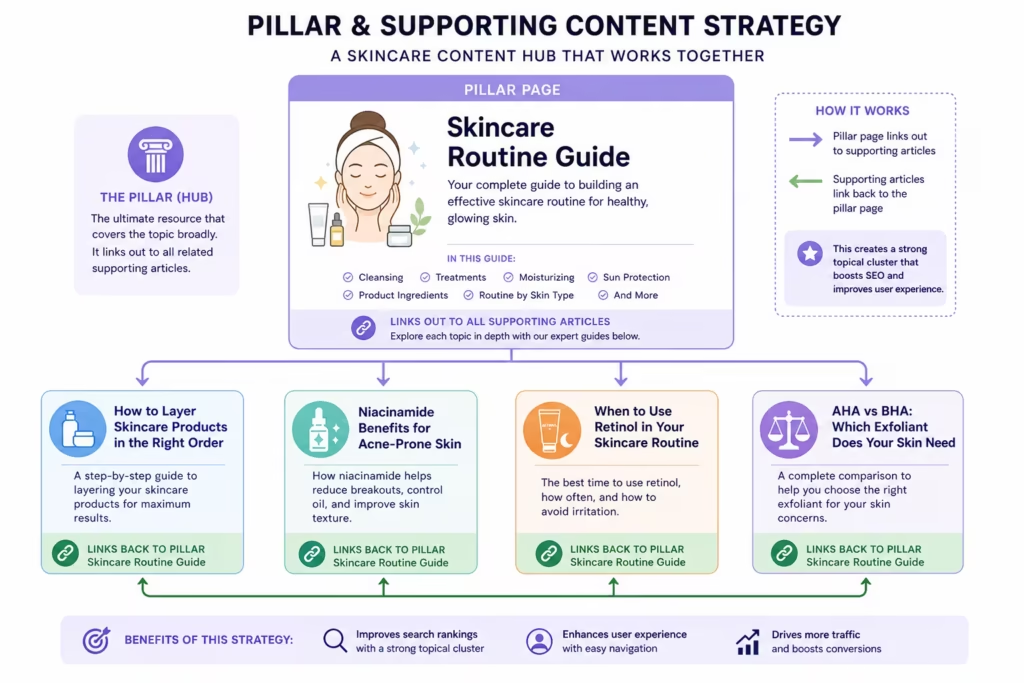
This architecture signals to Google that your site has genuine depth across the topic, which builds the topical authority that drives rankings across the entire cluster, not just individual pages.
The content itself needs to be genuinely useful. Google’s Helpful Content system, rolled out in 2022 and refined significantly in 2024, specifically targets content written for search engines rather than people. In practice, this means your skincare articles need to reflect real knowledge, real specificity, and real editorial standards. Generic “10 tips for better skin” content that could have been written by anyone about anything does not build authority. It dilutes it.
Technical SEO: the invisible work that matters
Good content strategy fails on a broken technical foundation. For cosmetics ecommerce, the same issues come up repeatedly.
Crawl budget waste
Large product catalogues with multiple filter combinations generate thousands of near-duplicate URLs. Search engines waste crawl budget on those instead of indexing important pages. Canonicalisation and robots.txt configuration fix it.
Site speed
Beauty sites are image-heavy. Uncompressed product images and poorly configured apps on Shopify routinely push load times past the point where Core Web Vitals start penalising rankings. Google’s PageSpeed Insights tool identifies exactly what’s slowing a site down.
Mobile experience
Over 70% of ecommerce traffic now comes from mobile, according to Statista. A cosmetics site not fully optimised for mobile is losing the majority of its potential organic traffic at arrival.
Orphan pages
Product pages with no internal links pointing to them receive almost no PageRank flow from the rest of the site and rank poorly. A systematic internal linking audit finds and fixes these gaps.
Local SEO for cosmetics brands with a physical presence
If your brand runs retail locations, pop-ups, or a studio alongside ecommerce, local SEO is a separate opportunity worth taking seriously.
Searches like “cosmetics store near me,” “skincare consultation London,” or “makeup counter [city name]” carry strong purchase intent and relatively low competition compared to national terms. Google Business Profile optimisation, local citation consistency, and location-specific landing pages are the 3 core levers here.
Physical presence, even occasional presence, signals legitimacy to Google in ways that a purely digital brand sometimes struggles to replicate.
How long does cosmetics SEO actually take
Longer than most agencies will tell you upfront.
For a new brand with a clean site and no existing organic presence, meaningful keyword movement typically begins around months 4 to 6. Category-level authority, where your brand ranks consistently for competitive terms across a broad topic, generally takes 9 to 18 months of consistent work.
That’s how Google’s trust signals accumulate. Domain age, content depth, backlink profile, user engagement. They build gradually. Brands that accept this timeline and invest consistently outperform brands chasing quick wins every single time.
When your cosmetics brand isn’t on Google
If your honest reaction to this article is “our site does almost none of this,” start with an SEO audit.
An audit tells you exactly where your site stands technically, how your product pages perform against real buyer searches, what content gaps are leaving traffic on the table, and what a realistic path to visibility looks like for your specific brand and category.
At SEOglaze, we’ve spent 12 years doing SEO for ecommerce industries. Beauty and cosmetics is what we focus on, from ingredient-led keyword strategy to product page optimisation to topical authority building.
If your cosmetics brand deserves better visibility than it’s currently getting, book a free SEO audit here. We’ll give you an honest picture of where you stand and what it would take to change it. No inflated promises. Just a clear view of what’s holding your brand back.